


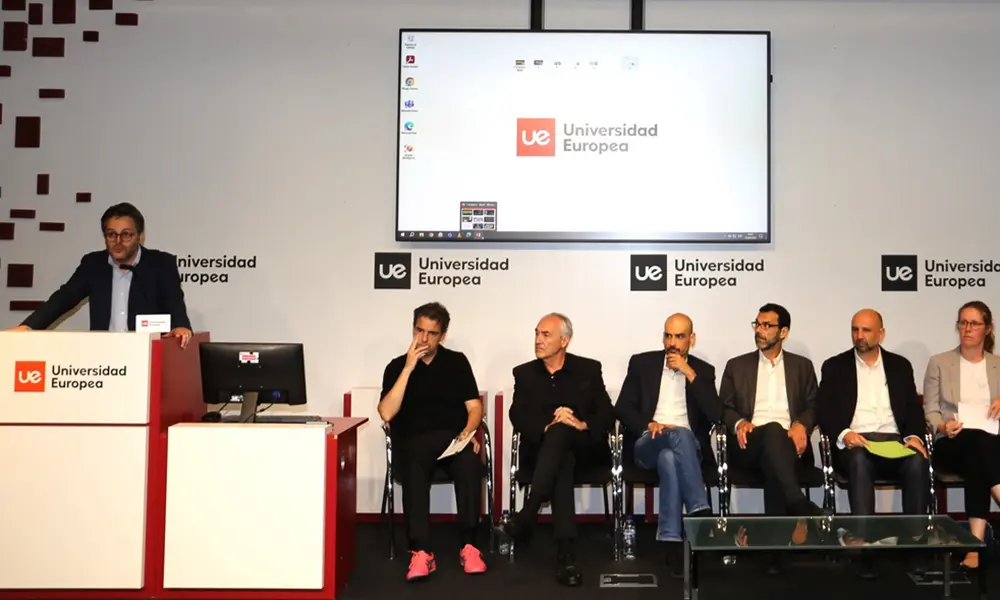
At the event “New sustainable urban developments: Opportunities linked to the internationalization of Madrid”, the project Madrid Nuevo Norte was presented, highlighting the importance of connectivity between cities, sustainability, and innovation in architecture.
Cutting-edge architecture is fundamental for a city that “must be able to capitalize on the population challenge and the boom Madrid is experiencing as a tourist city”.
Under this premise, Juan Claudio de Ramón, Deputy Director General of Networks and International Organizations of the Madrid City Council, began his speech at an event that brought together professionals from the world of architecture, members of the Madrid City Council, and the STEAM School of the European University.
The importance of connectivity in cities was one of the main topics discussed at the event held at the European University. In this regard, the president of the Metrópoli Foundation, Alfonso Vergara, explained how Madrid's connectivity will look in less than twenty years:
Madrid in 2040 will be a major connector between Northern Europe, with connections to Latin America and Africa. It will be a city that leverages its infrastructure and has direct connections to more than 160 cities. Traffic on the M-30 will be eased by the intersection points of the M-40, which will connect to the heart of Madrid through boulevards and feature ample green spaces.
José Luis Infanzón, General Director of Public Spaces and Infrastructure of the Madrid City Council, had the opportunity to present the Madrid Nuevo Norte project: “The sustainable city project must involve transforming into a productive, cohesive city with a high quality of life. We need to analyze vulnerable areas of cities and act on regeneration, considering sustainability elements like land use, mobility, urban complexity, biodiversity, and the relationship with green spaces”.
“Tourist attraction, new developments linked to sustainability, and energy developments”. These are some of the elements that Madrid must promote to internationalize its sustainable development model, according to Sigfrido Herráez, Dean of the Official College of Architects of Madrid (COAM). He introduced the concept of economic, public, and private sustainability, necessary to make sustainable growth and the internationalization of Madrid possible over time. He also emphasized the importance of controlling speculative growth, a major concern for Madrid's citizens.
The event also featured Lorenzo Fernández Ordóñez, professor at the European University, STEAM School, and co-author of the Plaza España remodel; Efrén García Grinda, visiting professor at the STEAM School of the European University; Mateus Porto, professor at the European University, STEAM School; Sigfrido Herráez, Dean of the Official College of Architects of Madrid; Virginia Vidal Lescuyer, civil engineer and member of the Governing Board of the College of Civil Engineers of Madrid; and David Solla, General Director of Madrid World Construction Capital. Architecture professionals highlighted the importance of promoting public transportation, reducing Madrid’s carbon footprint, and turning the city into a smart city, among other issues.


